The Course
30K. Three Rivers. One Point.
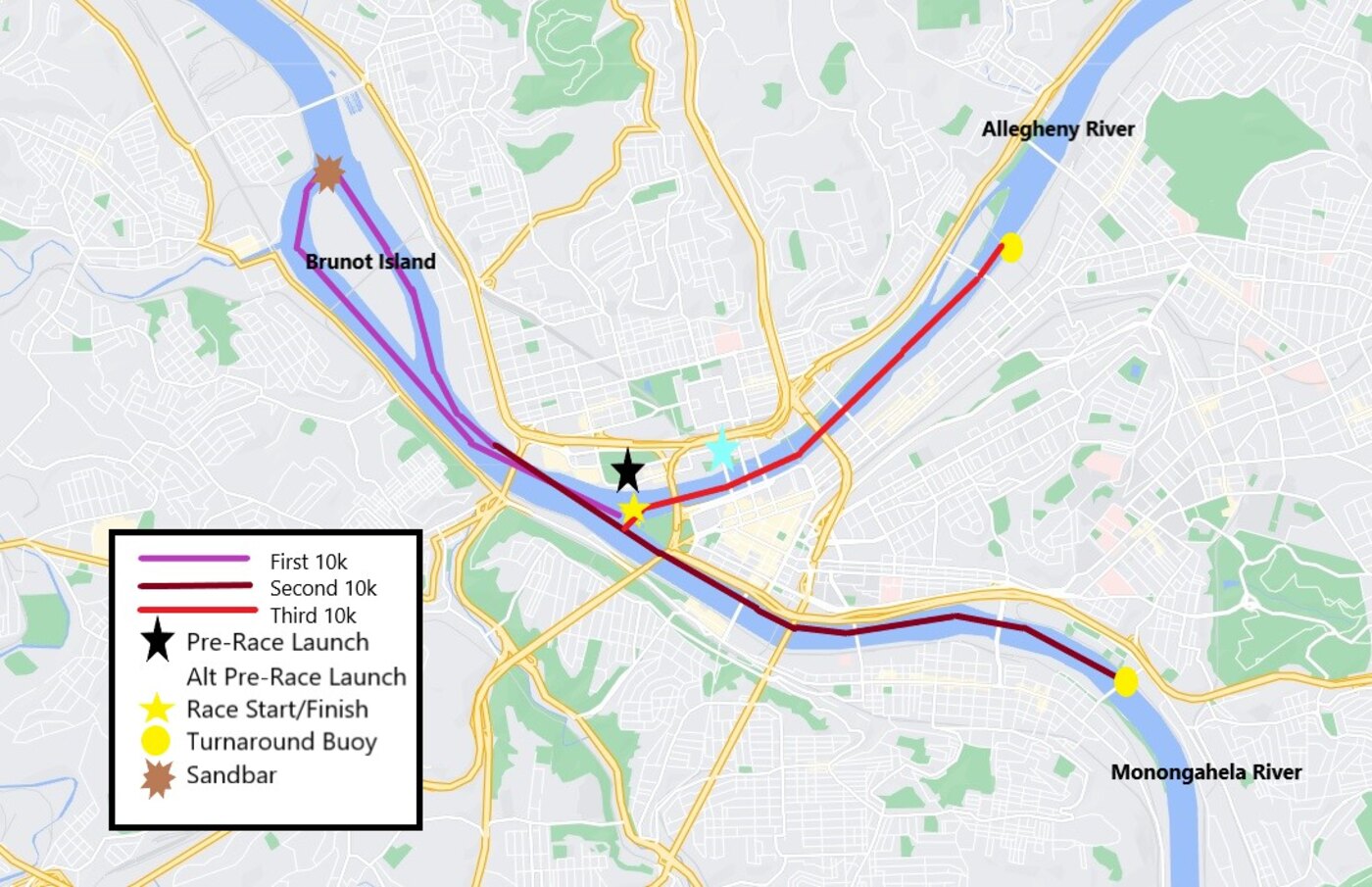
Roughly 30K — a 10K out-and-back in each of the Ohio, Monongahela and Allegheny Rivers, all starting and finishing at Point State Park.
Race day
How the day runs
We launch at 7:00 AM with powered escorts, kayaking teams and all crew from the North Shore, and head over to “the Point” (Point State Park) where swimmers begin with a water start from the Point State Park fountain.
The 3RMS is open for a water start of 8 marathon swimmers.
- Feeding. Swimmers are fed from a designated kayak. Additional supplies (water/supplements) ride on the second kayak. Should it be required, additional water is available aboard one of our powered escort boats, which patrol the course during the entire swim.
- Kayak support. Swimmers have two kayak volunteers flanking them at all times, with communication information provided in advance. Swimmers can bring their own kayakers and kayaks. Part of the entrance fee covers kayaks from 3 Rivers Outdoors, who have been kind enough to provide a discount.
- Finish. Swimmers exit the water via a powered escort and return to the North Shore location.
Leg by leg
The course
The Ohio River
Swimmers head north, current assist, along 5K of the Ohio River, turn around at Brunot Island, and swim 5K back against the current to the city. Guide boats escort swimmers across the middle of the river twice; the rest of the leg is run along the bank. Usually the calmest water of the day. Watch the sandbar at Brunot Island.
The Monongahela River
The 5-hour cutoff applies here. Swimmers must reach the Point and enter the Monongahela within 5 hours of the start; anyone outside that is pulled. At the Point State Park 10K mark swimmers turn into the Mon and swim against the current to the halfway point (15K) at the Hot Metal Bridge turnaround, then return to the starting point for the 20K mark. Stay on the city-side bank. Red buoys sit on the opposite side for the first three bridges — commercial traffic stays clear of them, so hugging the wall matters. Lunch is handed off from the flag at the Point.
The Allegheny River
Swimmers make the turn around the Point and head out against the current for 5K of the Allegheny to the 40th Street Bridge, then ride the current assist for the final 5K back down the city side of the Allegheny to the Point for a buoy finish. This is the fastest flow of the day on the way back and the slowest on the way up. River traffic is at its highest, the sun sets into your eyes, and power boats guide swimmers in past the Sister Bridges.
The details
Format, conditions & rules
Distance
Roughly 30K — 10K, out-and-back 5K, in each of the three rivers: (1) Ohio, (2) Monongahela and (3) Allegheny.
Format
Two kayakers per swimmer, powered escort boats, and Pittsburgh River Rescue / Pittsburgh Police / Coast Guard in support.
Water temperature
Wide range. Average +/– 72°F.
Water conditions
Usually calm during the first 10K on the Ohio. Boat traffic and potential headwinds churn up the Monongahela and the Allegheny. Overall, current is minimal. Keep in touch with local river conditions.
Time cutoffs
5 hours to enter the Monongahela at the 10K mark, and a strict 12-hour cutoff overall — a 4-hour 10K pace. Both are enforced without exception. Why.
Swimming attire
Standard marathon swimming costume — a porous textile suit, a latex or silicone cap, goggles. No wetsuit. Full rules below.
Cutoffs
Two cutoffs, both strictly enforced
5 hours — entering the Monongahela
You must reach the Point and cross into the Monongahela at roughly the 10K mark within 5 hours of the start. If you are not there, your swim ends there.
This one is about the crossing itself. The confluence is the heart of the Port of Pittsburgh, and moving a swimmer across it has to happen inside the window our safety boats and River Rescue have planned for. Outside that window we cannot put swimmers, kayakers and volunteers into commercial traffic.
It is also a hard truth about pace: a swimmer who needs more than 5 hours for the first 10K has almost no path to 30K inside 12.
12 hours — the full 30K
A strict 12-hour cutoff for all three legs, which works out to a 4-hour 10K pace.
Safety is the most important aspect of any marathon swim. Twilight sets in after the 12-hour mark, the Allegheny is at its busiest late in the day, and swimmers have to stay visible.
We know exactly how hard you have worked to get to that point. For the safety of every swimmer, kayaker and volunteer on the water, we enforce it anyway.
Why the confluence is the constraint
Our course runs through a working commercial waterway. The Port of Pittsburgh is the fifth busiest inland port in the nation and the 39th busiest port of any kind, moving millions of tons of cargo a year on the same rivers we swim. Barge and tow traffic cannot stop, cannot turn quickly, and cannot see a swimmer. Every crossing is timed around it.
Rules
Marathon swimming rules
The 3RMS is swum under the Marathon Swimmers Federation Rules of Marathon Swimming — the same standard used for the English Channel, Catalina and every other unassisted marathon swim. The summary below covers what matters on race day; the full text governs.
What you may use
The standard equipment of the sport. You do not need to declare any of it.
- One swimsuit of porous textile material. Men: no lower than the knee, no higher than the waist. Women: no lower than the knee, nothing onto the neck or past the shoulder.
- One cap, latex or silicone
- Goggles, earplugs, noseclips
- Sunscreen and grease
- Safety lights for visibility
- A simple watch — time of day and elapsed time only
- Your escort boat, pilot and crew
- Nutrition, and the gear used to pass it to you
- Kayakers and support swimmers
- An observer
What you may not use
Anything that helps your speed, buoyancy, warmth or endurance makes the swim assisted rather than unassisted.
- No wetsuit, neoprene cap, booties or gloves — nothing that retains heat
- No fins, paddles or shark cage
- No pull buoy or anything that adds buoyancy
- No music players or metronomes for pacing
- No wearable that transmits anything to you beyond the time
- No underwater streamers
- Nothing on the World Anti-Doping Agency prohibited list
Gear you can use, but must declare
Some equipment gives no performance benefit but still is not standard: a stinger suit or rash guard, a wildlife deterrent, or a device that logs data without showing it to you. A swim using these still counts as unassisted — but tell us in advance so it goes in the swim documentation.
The core rules
- Nonstop. Once you start you stay in the water until you finish or stop. No intentional contact with the escort boat, the kayaks, the crew, or any fixed or floating object. If a boat or crew member touches you by accident, the observer decides whether the swim continues.
- Navigation and pace are yours. You pick your line and your speed. The pilot can suggest, but cannot compel. You do not have to swim straight.
- Currents are fair game; drafting is not. Riding a current is part of the sport — the whole back half of each leg is a current assist. But the only thing propelling you is you: no drafting off a boat, a kayak, or another swimmer, and no pacing assistance.
- Feeding. Food, drink and gear are handed to you from the kayak or the escort boat. You may not be supported or pulled along by the exchange. Your crew can talk to you at feeds and whenever else it matters.
- Support craft. Kayaks, paddleboards and support swimmers may accompany you as long as they never hold you up or pull you. A support swimmer stays beside you, never in front — swimming ahead of you is drafting.
- The pilot is in charge. By starting the swim you accept the pilot's authority on the water. The pilot, with the observer and crew, can end a swim at any time for any reason, safety first.
- The observer decides on rules. The observer documents the swim — times, temperatures, locations, equipment — and is the sole authority on whether the rules were followed.
On top of the MSF rules, the 3RMS runs a water start at the Point State Park fountain, a buoy finish, and a strict 12-hour cutoff. Rules of Marathon Swimming © the Marathon Swimmers Federation — summarized here, published in full at ultraswimming.org/rules.
Friends & family
Where to watch
There is no room for family and friends on the escort boats. Past participants have rented a boat for the day to follow along — tiki boat and pedal boat rentals both operate on the rivers.
The finish is at the Point
Swimmers finish on a buoy at Point State Park, right off the fountain where they started. This is the main cheering section — it is where the crowd gathers, where the families wait, and where every swimmer comes in.
You can walk or ride the river trail the whole way alongside them for the last stretch and follow them in.
When to be there
Swimmers launch at 7:00 AM and start shortly after, so working from a 7:00 AM clock:
- ~2:30 PM — the earliest anyone has ever finished. The course record is 7:27:26.
- ~4:00 PM — a typical finish. Most swimmers come in around 9 hours.
- 7:00 PM — the 12-hour cutoff. The last swimmers are in by then.
If you only come for one thing, be at the Point by 3:30 PM and you will not miss much.
Follow along by bike
This is how most of our observers do it. Electric bikes are available to rent all over the city, and the riverfront trails track the course closely enough that you can leapfrog your swimmer most of the day.
Ohio leg
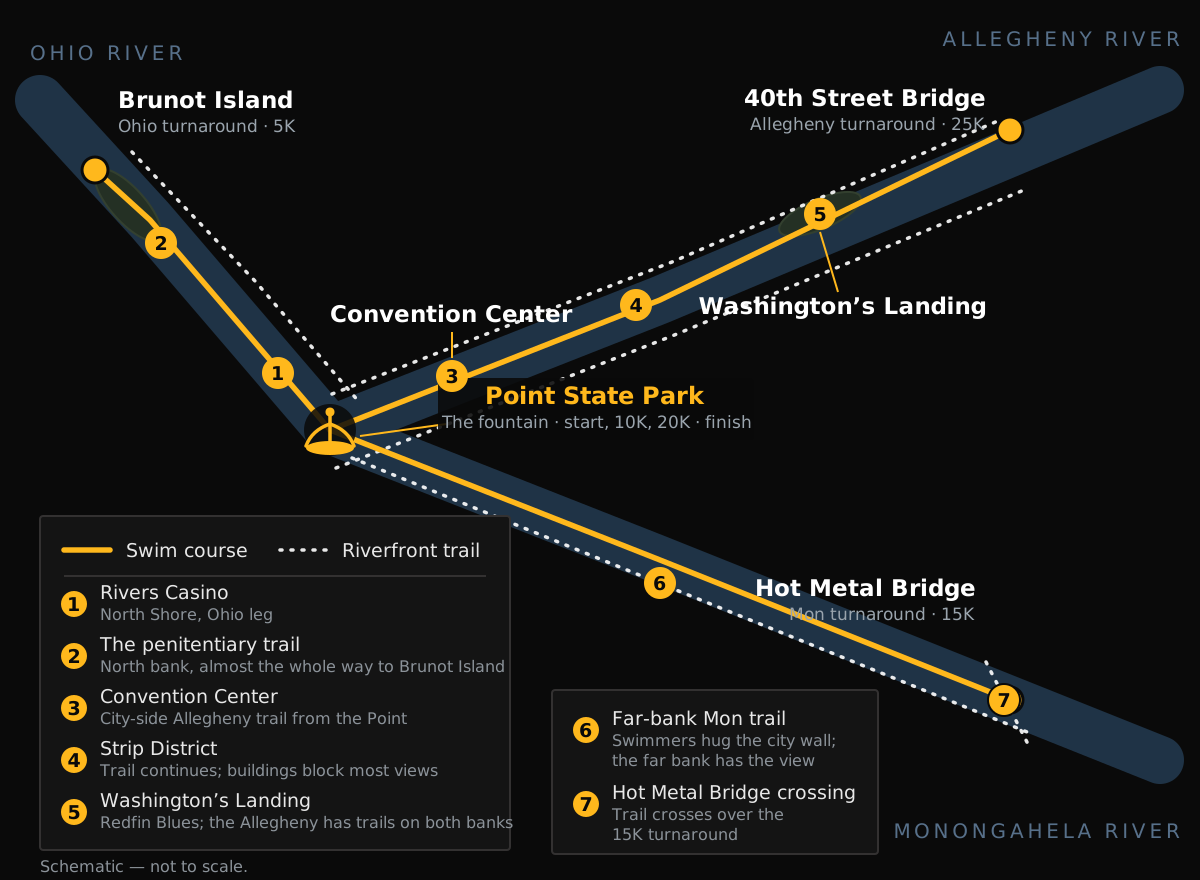
The trail runs along the north bank — the same side as the penitentiary and Rivers Casino — and carries almost all the way out to Brunot Island, so you can follow the first 10K out and back without leaving it.
Monongahela leg
Best viewed from the trail on the opposite bank from the swimmers — they hug the city-side wall, so the far side gives you the view. The bike trail crosses the Hot Metal Bridge, which puts you directly above the 15K turnaround.
Allegheny leg
The Allegheny has trail on both banks, so you can pick your side. The city side runs from the Point up past the Convention Center and on into the Strip District, where the buildings cut off most of the sightlines. Keep going up to Washington’s Landing for another clear viewpoint.
On foot
Point State Park
The start, the 10K and 20K marks, the 28K mark, and the finish. You can walk the river trail the whole way to follow swimmers in.
Rivers Casino
Roughly the 8K mark on the Ohio leg.
Convention Center
Roughly the 23K mark on the Allegheny leg.
Redfin Blues
On Washington’s Landing, with a view of the 25K turnaround buoy. You have to eat there to have the view.
Pre-race meeting point, parking and hotel information: to be added